
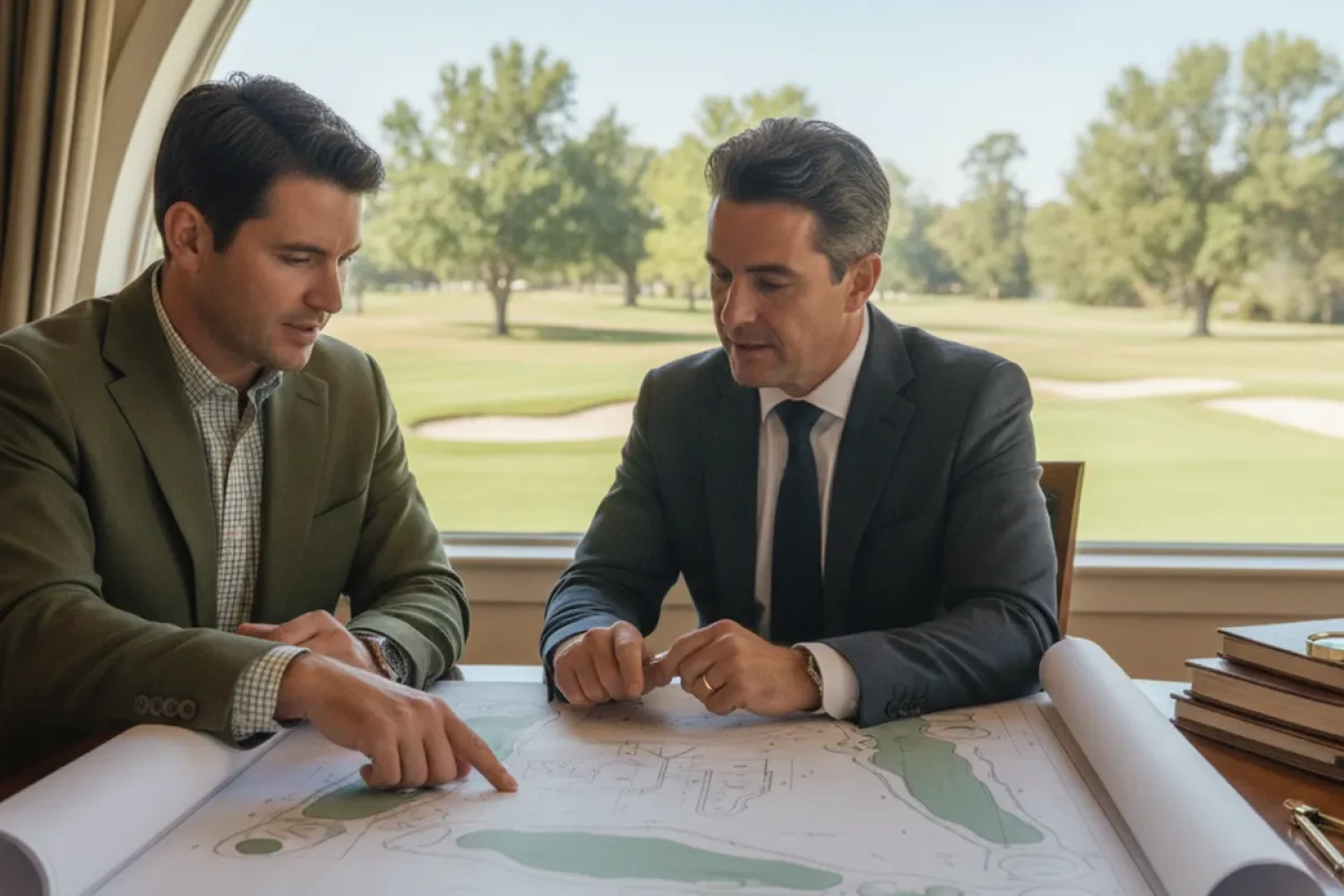
A golf course feasibility study template helps an owner, operator, or qualified buyer organize the questions that matter before committing to a major property decision. The right template is not a one-size-fits-all verdict. It is a structured way to test the property, market, operating model, risks, and available paths against evidence. Use the framework below to identify what you know, what remains uncertain, and which specialists should help answer open questions.
Call Fairway Advisors to discuss your course
What is a golf course feasibility study template?
Think of the template as a decision document, not a prediction. It should make the central question explicit: what action is being considered, for whom, and under what conditions? A study for an owner weighing a sale is different from an operator considering a major operational change or a qualified buyer assessing an acquisition. The scope needs to match the decision.
A useful study distinguishes verified information from estimates and opinions. For example, a property record, a manager’s account, and a future demand assumption are not interchangeable. Label each item, identify its source, and record when it was reviewed. That discipline lets a board, owner, or investment team challenge an assumption without losing track of the underlying evidence.
There is no universal form that answers every golf-property question. Course layouts, ownership structures, club obligations, local competition, land use, and operating arrangements vary. Treat this guide as a working framework and adapt it to the property and the decision. A university business-plan template, for instance, emphasizes stating the business concept and describing how the venture is organized; the same clarity helps define the scope of a feasibility inquiry (university business-plan template).
How should you define the decision and scope?
Write a brief scope statement before collecting records. It should describe the property and the intended use of the study in plain language. Identify whether the analysis concerns an operating golf course, a private club, a resort property, a land-use question, a potential purchase, a sale, or a change in operating strategy. Where relevant, state whether the entire property or only a defined part is being considered.
Then frame the decision questions. Examples include whether the current operating model is sustainable, whether a proposed change fits the market and property, what information a buyer would need to evaluate an opportunity, or what issues could affect a sale process. Keep questions neutral. A feasibility study should test an idea rather than be written to prove it is right.
Record who will use the study and who can approve action. An owner, club board, lender, operator, and qualified buyer may need different levels of detail. For a member-owned club, clarify governance requirements, member obligations, and how decisions are authorized. For an owner considering a transaction, define who may receive confidential information and how inquiries will be handled.
- Decision to assess: Describe the proposed action without assuming its outcome.
- Property boundary: Identify the course, facilities, land, and related assets included.
- Audience: Name the decision-makers and any advisors who need the findings.
- Questions: List the specific issues the study must resolve.
- Exclusions: Note topics outside scope, such as a detailed engineering design or formal legal opinion.
For an owner exploring a possible sale, the scope may connect to a broader guide to selling a golf course. A study for a buyer may instead focus on the specific diligence questions needed to understand the property and its operating obligations.
What property and site information belongs in the template?
Start with a property profile. Include the course configuration, practice areas, clubhouse, maintenance facilities, cart storage, parking, food and beverage spaces, lodging if applicable, and other amenities. Describe how each component is used and whether it is owned, leased, shared, or subject to a separate agreement. Attach a site plan when available and identify the version and source.
Review the land and built environment as a connected system. Note topography, water features, drainage patterns, access roads, utilities, easements, and visible condition issues. Record known maintenance needs in general terms, without treating a visual walkthrough as an engineering inspection. Significant infrastructure questions may require qualified engineering, environmental, agronomic, or building professionals.
Make a records checklist that can be completed with the appropriate specialists. Possible records include deeds and surveys, title materials, zoning and land-use documents, permits, environmental reports, water rights or supply records where relevant, leases, service agreements, equipment inventories, and building or infrastructure assessments. The list will depend on jurisdiction and property structure; the template should not imply that a document is available or that a legal requirement applies everywhere.
For every record, capture its date, source, and relationship to the property. Check whether the document covers the whole course or only a portion, whether later changes may have superseded it, and whether it refers to a neighboring parcel or shared facility. A short index makes it easier to see which parts of the site are well documented and where the study relies on interviews or observation instead.
When describing condition, separate immediate observations from conclusions about cause or cost. A wet area, worn surface, or aging system may prompt questions, but it does not by itself establish the underlying issue or remedy. Record the location and circumstances, then identify the right specialist to investigate. This avoids turning a preliminary walk-through into an unsupported technical finding.
Also document how the property functions in practice. A map may not show how circulation, maintenance access, drainage, or shared facilities affect daily operations. Pair the records review with a site walk and interviews with people familiar with the property. Note observations, dates, participants, and follow-up items separately from conclusions.

- Property overview: Location, ownership structure, boundaries, and included components.
- Course and facilities: Layout, amenities, support buildings, and current uses.
- Condition: Observed issues, reported projects, and independent assessments still needed.
- Land and access: Easements, road access, utilities, drainage, and known land-use constraints.
- Open questions: Records to request and the professional best placed to review them.
When a decision depends on an understanding of value, keep the property facts and the value analysis distinct. Fairway’s guide to golf course value factors can provide context, but a feasibility study should not substitute a general template for property-specific analysis.
How can you assess market demand and competitive context?
Define the market area in a way that fits the question. A daily-fee course may draw from a different area than a destination resort or private club. Consider travel patterns, access, population and employment context where relevant, tourism or seasonal influences, and the presence of other recreation choices. Do not assume that a broad national trend describes the conditions around a specific property.
Describe the customers and users the property serves now, as well as groups it may reasonably serve under a proposed plan. For a club, consider membership structure and member priorities. For a public-facing facility, examine play patterns, booking channels, visitor mix, and service expectations. For a resort property, assess how golf relates to lodging, events, and other amenities. Use records and interviews where available rather than relying only on anecdotes.
Map the competitive and complementary landscape. Include other golf offerings and alternatives such as recreation, hospitality, or development uses when they are relevant. Compare practical factors: location, access, course condition, facilities, customer experience, operating model, and seasonality. The purpose is not to create a list of names; it is to understand why users choose one experience over another and which differences matter.
For each demand assumption, record the basis. Is it supported by operating records, local interviews, public information, a professional study, or simply a working hypothesis? If the evidence is incomplete, state that plainly. Consider more than one plausible scenario and show what would have to be true for each scenario to hold. Avoid presenting a single forecast as certainty.
Useful research can include conversations with customers, club members, nearby businesses, tourism organizations, and local officials, when appropriate. Use a consistent set of questions and record the date and context of each conversation. Treat comments as perspective, not as a representative survey unless a qualified research method supports that conclusion. Publicly available planning documents may also reveal proposed changes to nearby roads, land use, or recreation that affect the market picture.
Ask whether the course’s position is based on a durable advantage, a temporary condition, or a constraint that could change. Access, service quality, course condition, customer mix, and relationships with lodging or other amenities may all matter. Make the comparison concrete: explain what the subject property offers, what users can choose instead, and what evidence supports the distinction.
Which operating and organizational factors should be reviewed?
Review the operating model from the user’s arrival through the end of the visit. Consider tee-time and membership administration, golf operations, course maintenance, food and beverage, events, retail, security, customer service, and facility upkeep. The relevant functions differ by property, so identify what is in-house, contracted, shared, or not currently offered.
Describe the organization behind the operation. Note reporting lines, key responsibilities, seasonal staffing needs in general terms, training, and areas where knowledge rests with one person. Identify whether operating agreements, vendor arrangements, employment practices, or club rules may affect a proposed transition. These are review topics, not legal conclusions; qualified counsel or other specialists should assess documents and obligations.
Consider the relationship between the golf course and the rest of the property. A club may rely on member participation, while a resort may depend on coordinated service across lodging and recreation. A change in use, ownership, or operating responsibility can affect the whole guest or member experience. The template should call out dependencies rather than reviewing the golf course as an isolated asset.
Use operating records to identify patterns and questions, not to imply that one period guarantees future results. Organize relevant records by function, explain any gaps, and note unusual events or changes in how information was collected. The goal is a transparent picture of the operation that can be examined and updated.

How should you organize financial and transaction information?
Financial information is an important part of many feasibility questions, but this template is not a valuation formula or a substitute for professional analysis. Collect the records relevant to the decision, such as operating statements, budgets, capital plans, membership or customer records in appropriately protected form, debt and lease documents, and material contracts. The exact scope depends on the property and the intended use.
For each item, note the period covered, who prepared it, whether it is final or preliminary, and any known limitations. Reconcile differences between reports instead of silently selecting the version that supports a preferred conclusion. Keep source documents separate from working assumptions, and control access to sensitive information.
Where analysis is needed, show the method and assumptions in a way that can be reviewed. Label projections as projections. Explain which operating changes, market conditions, or property issues drive the result. Avoid presenting unsupported precision: a scenario is only as reliable as its inputs, and an estimate should not be mistaken for an established fact.
If the study is connected to a possible sale, acquisition, or ownership change, think early about how confidential documents and inquiries will be managed. Fairway’s overview of sale confidentiality explains why controlled information handling matters. A qualified buyer may need deeper information as discussions progress, but access should be managed thoughtfully and with appropriate professional guidance.
Fairway’s transaction-focused business plan resource may also help owners organize the operational story behind the records. For a specific transaction, have the relevant accounting, legal, operating, and transaction professionals identify the materials needed and interpret them in context.
What risks, constraints, and alternatives should the study compare?
Risks can arise from the site, operations, market, governance, agreements, regulation, environmental conditions, or information gaps. Capture both known issues and matters that are not yet verified. For each item, write down the evidence, possible consequence, responsible reviewer, and next step. This prevents a concern from disappearing into a general paragraph.
Consider uncertainty as a set of questions. What happens if an assumption proves wrong? Which conditions are outside the owner’s control? What information would materially change the decision? Separate issues that can be managed through planning from issues that could change whether the proposed path is feasible.
Compare alternatives that are genuinely available to the decision-maker. Depending on the assignment, these might include continuing the current operation, making a defined operational change, pursuing a transaction, considering a different ownership structure, or seeking additional analysis before acting. Do not assume that every alternative suits every property. Identify prerequisites, stakeholders, and trade-offs for each route.
Use common comparison criteria so readers can weigh options consistently. The table below is a simple worksheet; adapt the evidence column to the actual property and attach records where possible.
| Study area | Questions to answer | Evidence to record | Open action |
|---|---|---|---|
| Property and site | What assets, conditions, or constraints shape the decision? | Plans, records, observations, specialist reports | Request missing documents or independent review |
| Market and users | Who uses the property, and what alternatives do they have? | Operating records, local research, interviews | Test assumptions and note evidence limits |
| Operations | Can the current or proposed model be carried out? | Agreements, organization details, process records | Clarify responsibilities and dependencies |
| Risks and alternatives | What could change the outcome, and what other paths exist? | Risk register, constraints, scenario assumptions | Assign a reviewer and decision owner |
How do you turn the findings into a useful recommendation?
A clear report can follow a practical sequence: purpose and scope; executive summary; property description; market context; operating review; records and analysis; risks and constraints; alternatives; conclusions; and recommended next steps. The order can change, but readers should be able to see how the findings lead to the recommendation. The report should give readers a clear overview before moving into supporting details, so the purpose and conclusion are easy to find.
For each recommendation, state the supporting evidence, assumptions, conditions, and unresolved questions. If the evidence is mixed, say so. If a conclusion depends on an inspection, approval, agreement, or additional research, identify that dependency. A responsible recommendation may be conditional or may advise gathering more information before choosing a path.
Keep the executive summary concise but substantive. It should tell a busy reader what decision was studied, what the analysis found, and what action is proposed. Avoid introducing new claims in the summary that do not appear in the report. Use appendices for detailed source lists, interview notes, maps, and technical material that decision-makers may need to inspect.
Before circulating the final document, check that dates and versions are clear, sources are identified, assumptions are labeled, and sensitive information is protected. Ask someone who did not prepare the analysis to review whether the decision and supporting evidence are understandable. A study should be useful to its actual audience, not merely complete as a file.
When should a golf course owner or buyer seek specialist advice?
A feasibility study often requires different kinds of expertise. Engineers may assess infrastructure and drainage; environmental professionals may review environmental conditions; land-use counsel can address property rights and local requirements; accountants can examine financial records; and golf operations professionals can assess service and maintenance issues. Engage each specialist for a defined question and ask how findings should be interpreted.
Transaction advice can help connect property, operating, and market questions to a potential sale or acquisition. Owners may find it useful to understand how information will be presented, how confidentiality is managed, and how qualified buyers are assessed. Buyers may need support organizing their search and identifying property-specific diligence questions. Fairway Advisors provides golf course brokerage and advisory services for both sides of a transaction; learn more about its golf course advisory services.
For an owner comparing representation options, Fairway’s guide to choosing a golf course broker offers questions to consider. An owner preparing records may also consult the golf course sale preparation guide. These resources can help shape a conversation; they do not replace advice tailored to a particular property.
Keep the scope of each advisor clear. A broker does not replace legal, accounting, engineering, environmental, or other specialist review. Likewise, technical reports may answer important property questions without determining which transaction or ownership path fits an owner’s goals. Coordinated advice works best when the decision-maker understands each person’s role.
Call Fairway Advisors to discuss your course
Frequently Asked Questions
Is there one standard golf course feasibility study format?
No. The useful format depends on the property, decision, audience, and questions being investigated. A consistent outline can help organize the work, but the sections and depth should be tailored to the assignment.
Can I use this template to determine what a golf course is worth?
No. It can help organize property and operating information relevant to a decision, but it is not a valuation method or conclusion. Property-specific value analysis requires appropriate data, methods, and professional judgment.
What should I do if important records are missing?
List each missing item, explain why it matters, identify who may hold it, and assign a next step. Note how the gap affects the analysis. Do not present an assumption as verified simply because a record is unavailable.
Can an owner use the study when considering a sale?
Yes. A study can help an owner organize property facts, operating questions, constraints, and confidential information before discussing a possible transaction. The scope should be tailored to the owner’s goals, and sensitive records should be shared only through an appropriate process.
Who can help adapt the template to a particular course?
Depending on the questions, the owner may need golf-specific transaction advice along with legal, accounting, engineering, environmental, or operating expertise. Each professional should be asked to address the part of the decision within their experience.
Call Fairway Advisors to discuss your course
Discuss your feasibility questions
Call Fairway Advisors to discuss your course
If you are considering a golf course sale, acquisition, or advisory question, contact Fairway Advisors to discuss the situation and the expertise that may be relevant. A focused conversation can help clarify the appropriate next step for your property.