
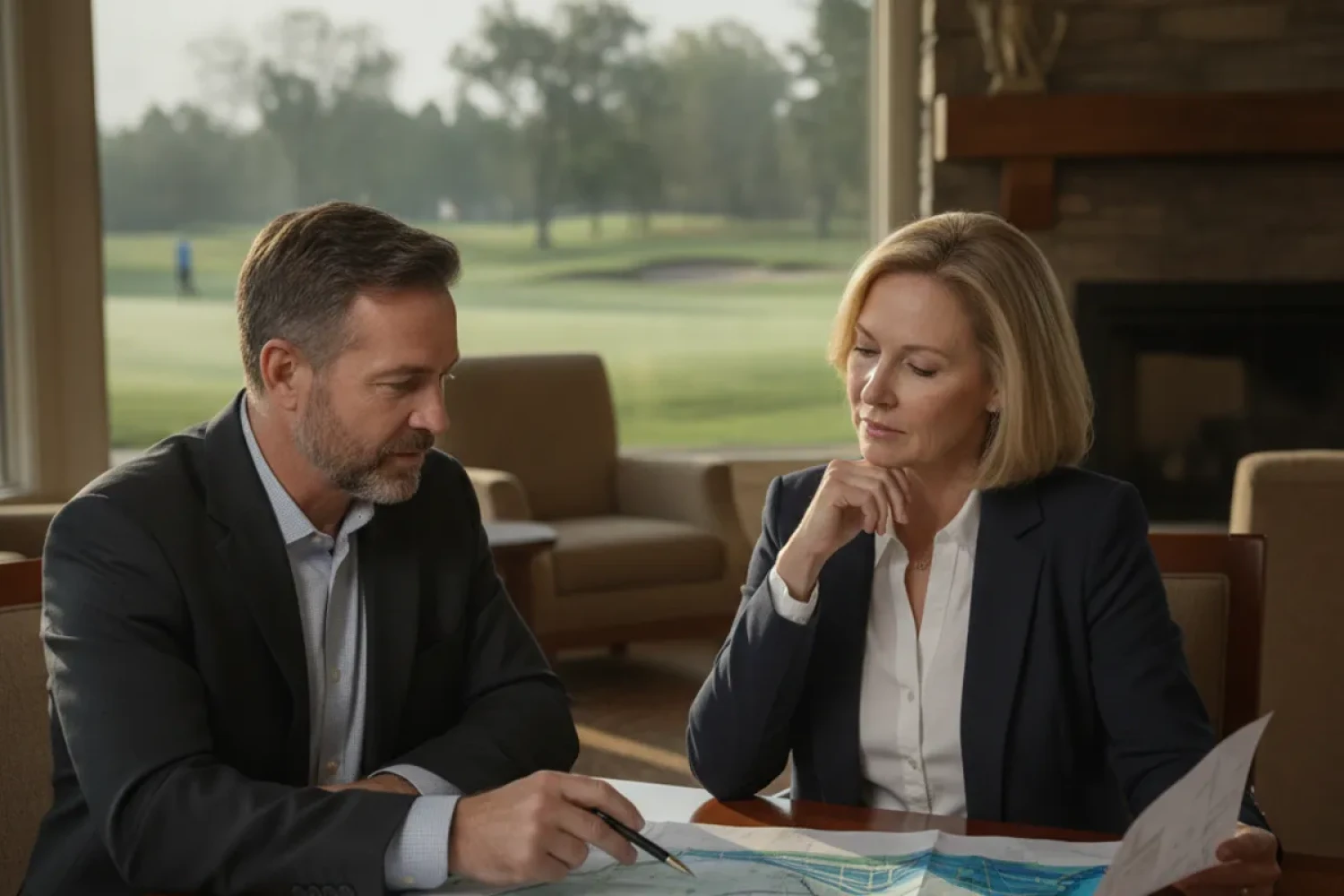
A golf course business plan should do more than describe the property. It should connect ownership goals with the course’s customers, operations, staffing, capital priorities, risks, and financial outlook. A clear plan helps owners and managers make consistent choices, explain the business to stakeholders, and identify questions that need expert attention.
Call Fairway Advisors at (214) 485-1500 to discuss your course
Explore golf course advisory services
What is a golf course business plan?
Unlike a short promotional overview, a useful plan explains how the golf facility functions as a business. It considers the golf operation alongside the other parts of the property, such as food and beverage, events, retail, practice facilities, lodging, or real estate interests when those apply. The plan should distinguish current conditions from future assumptions, and it should make clear who is responsible for each action.
The document does not need to be elaborate to be useful. It does need to be specific to the property. A private club with member governance has different priorities from a daily-fee course, resort, or multi-course operator. A plan that simply borrows generic language may miss the decisions that matter most to that ownership group.
Think of the plan as a shared reference point, not a promise that every forecast will come true. Its job is to help decision-makers understand the business, compare choices, and respond deliberately when operating conditions or ownership priorities shift.
Who should use a business plan for a golf course?
For an owner, the plan can organize priorities around the future of the property, including operational improvements, stewardship, succession, or a possible change in ownership. When a sale, acquisition, refinancing, or lender review may be part of the future, the plan should also separate operating facts, assumptions, ownership objectives, and open diligence questions. That does not turn the plan into a marketing package, but it helps an owner decide what needs to be clarified before a transaction conversation. For a general manager, it can translate those priorities into departmental responsibilities and reporting. A member-owned club may need a plan that explains governance, member expectations, and how leadership will weigh competing needs.
Investors and lenders may look for a clear account of the property’s business model, operating context, opportunities, and risks. They will still conduct their own review; a business plan is not a substitute for transaction diligence or professional advice. For an operator responsible for more than one facility, a plan can also show what is specific to each course and which practices can be shared across the portfolio.
Before writing, answer three questions: Who is the primary reader? What decision should the plan help that reader make? What evidence would make the plan credible to them? Those answers determine what belongs in the document and what level of detail is appropriate. If several audiences need it, name the primary one and make supplementary sections for others rather than trying to address everyone in every paragraph.
What should a golf course business plan include?
A practical outline gives readers a route through the business, from its current position to the actions being considered. Use plain language, label assumptions, and support important statements with records or observations where possible.
| Section | Questions to answer | Useful supporting material |
|---|---|---|
| Overview and objectives | What is the facility, who owns or governs it, and what outcomes matter? | Ownership priorities, mission, decision roles |
| Property and market | What assets, customer groups, and competing leisure choices shape demand? | Property information, customer feedback, local context |
| Operations and people | How are golf, grounds, clubhouse, and supporting functions managed? | Operating procedures, staffing structure, service standards |
| Marketing and customer experience | How does the course attract, serve, and retain its intended customers? | Customer communications, participation and feedback records |
| Financial outlook | What are the key revenue sources, cost drivers, assumptions, and resource needs? | Financial statements, budgets, documented assumptions |
| Risks and action plan | What could disrupt the plan, and who will act on each priority? | Risk register, responsibilities, review measures |
Executive overview and ownership objectives
Write the overview after the rest of the plan, even if it appears first. Summarize the course’s current position, the plan’s purpose, the priorities it addresses, and the decisions needed from its readers. Avoid broad claims such as “improve performance” unless the plan says what that means for this facility.
State the ownership objectives directly. Goals might concern the customer experience, operational resilience, course condition, community role, or future ownership planning. If owners or members disagree on priorities, document the open questions rather than implying that consensus already exists.
Property, market, and customer context
Describe the facility accurately: its format, amenities, access, condition, and relationship to its surrounding market. Identify the customers the business serves and the reasons they choose this course. Separate observed information, such as customer feedback or booking patterns, from assumptions about future demand.
Consider how the facility is positioned among other local recreation and hospitality choices without turning the plan into a list of competitors. Explain the property’s own strengths and limitations. Where information is incomplete, say what still needs to be verified and how the owner or operator will obtain it.
Operations, staffing, and customer experience
Show how core functions fit together. Depending on the course, these may include golf operations, agronomy and grounds, clubhouse services, food and beverage, events, retail, and facility maintenance. Explain reporting relationships, service expectations, seasonal considerations, and the handoffs between teams.
Staffing is more than a list of job titles. Identify critical roles, training needs, coverage concerns, and processes that rely heavily on one person’s knowledge. Describe how management will maintain service while addressing operational constraints. Keep maintenance language grounded in the specific course’s needs; avoid generic promises about condition or unsupported claims about savings.

Marketing, sales, and customer relationships
Explain which customer groups the course intends to serve and how the offer fits their needs. A plan might address membership or pass programs, public play, outings, instruction, events, or resort components where relevant. Describe how customers learn about those offerings, make reservations, receive service, and share feedback.
Make the marketing plan operational. Name the channels and responsibilities, set measures that the team can actually monitor, and connect promotion to available capacity and the experience delivered. Avoid treating more inquiries as the only goal; repeat use, customer satisfaction, and fit with the course’s operating model may also matter.
Financial outlook, capital priorities, and assumptions
Financial planning should use the course’s own records and clearly stated assumptions. Identify major sources of income, material cost categories, obligations, and the resources needed to carry out the plan. Consider how weather, course condition, customer mix, staffing, and facility investments could affect operating results.
Keep forecasts distinct from established facts. Explain what information supports an assumption, who prepared it, and what would cause the owner to revisit it. When the plan considers capital improvements, describe the business need, operational impact, alternatives, and approval process. Avoid presenting a projected outcome as guaranteed or using a broad industry benchmark as if it automatically applies to one property.
For decisions with significant financial or ownership consequences, bring in qualified professionals with relevant golf-course experience. A plan can organize the questions, but it should not replace a property-specific financial review or legal, tax, engineering, environmental, or other advice when needed.
Transaction readiness and decision support
When a transaction is a real possibility, add a transaction-readiness layer to the business plan without confusing it with a listing package or diligence report. Identify the property records that need to be organized, the ownership or governance approvals that may matter, the operating assumptions that need support, and the questions a qualified buyer, lender, or seller will reasonably ask.
Consider an owner who is evaluating a sale and compares the business plan with current operating records. The plan may describe strong customer demand but fail to explain staffing dependence, deferred facility needs, or governance approvals. Resolving those gaps changes the next decision: instead of making a broad marketing claim, the owner can assemble property records, clarify responsibilities, and ask a golf-course broker which questions a qualified buyer is likely to raise. An acquisition-minded operator can use the same framework to identify which assumptions require diligence before moving forward.
This transaction focus also protects the operating plan from becoming vague. Keep routine management priorities in the main operating sections, then create a clearly labeled transaction-readiness section for records, open questions, decision authority, and advisor roles. The result is more useful to owners and more understandable to the professionals who may support the next stage.
Risks, responsibilities, and measures
List the internal and external risks that could change the plan’s priorities. Depending on the course, these may include weather exposure, aging facilities, water or other resource constraints, staffing challenges, customer concentration, governance issues, or changes in the surrounding market. Explain how management will monitor each risk and who owns the response.
Choose a small set of measures that connects to the stated objectives. Measures might track customer experience, operating consistency, facility condition, participation, or financial performance. Define each measure, identify its source, and assign someone to review it. A measure without an owner or a decision attached to it is unlikely to improve the plan.
How do you build the plan from reliable information?
- Set the purpose. Write down the decision, planning need, or shared objective the document is meant to support. Define who will approve it and who needs to use it.
- Assemble source material. Collect operating reports, budgets, customer feedback, property records, staffing information, policies, and prior planning documents that apply. Note gaps rather than filling them with guesses.
- Listen across the operation. Ask ownership, management, grounds, clubhouse, and customer-facing teams where the plan matches daily reality and where it does not. For a member-owned course, include the appropriate governance perspectives.
- Describe the current position. Summarize the course’s assets, services, customer groups, operating constraints, and decision structure. Use current evidence and identify its source.
- Set priorities and choices. Explain what the business will focus on, what it will not prioritize, and why. Address trade-offs directly, including service, staffing, facility, and resource implications.
- Assign actions and review points. Give each action an owner, a way to assess progress, and a point at which leadership will reconsider the assumption or decision. Keep this useful rather than creating reporting for its own sake.
The U.S. Small Business Administration offers general business-planning resources at its official website. General guidance can help structure the exercise, but a golf facility has operating and property considerations that require course-specific detail.
As a quality check, ask a manager outside the writing process to explain the plan’s main priorities in their own words. If the reader cannot tell what decision is needed, who owns the next action, or which statements are assumptions, revise the document before circulating it more widely.

How should the plan differ by course and ownership model?
A private club may need to give particular attention to membership expectations, governance, capital decisions, and communication between management and members. A member-owned club should explain which decisions belong to the board, committees, membership, or management, based on its governing documents and established practice.
A daily-fee or semi-private course may focus more on customer acquisition, tee sheet utilization, service consistency, and the balance between public play and repeat customers. A resort operation may need to connect golf with lodging, events, food service, and the broader guest experience. For a multi-course operator, each property needs its own market and operating profile even if some policies or systems are shared.
These are planning distinctions, not rigid templates. A facility may combine several models, and its plan should reflect that reality. Do not copy a section just because another course has it; include it when it informs a decision or helps a reader understand the business.
How can owners keep the plan useful?
Assign a person to maintain the plan and identify who can approve material changes. Keep supporting schedules and working details in appendices so the main document remains readable. Record the date and source of important information, especially when it is likely to change.
When conditions shift, review the assumptions affected by that change instead of rewriting every section. For example, a change in customer mix may require a fresh look at staffing, service delivery, and marketing. A facilities issue may affect capital priorities, operations, and the financial outlook. Note the decision made and the reason, so later readers can understand how the plan evolved.
A plan also benefits from a clear distinction between strategic direction and day-to-day procedures. The plan should explain the objectives and responsibilities; detailed operating manuals, budgets, and policies can remain in their own documents and be referenced where useful.
When should a golf course owner seek outside guidance?
Owners may seek help when internal records do not answer important questions, when stakeholders interpret the same information differently, or when a decision could materially affect the property’s future. The relevant advisor depends on the issue: operational specialists, financial and legal professionals, engineers, environmental consultants, or golf-course brokers may each have a distinct role.
If a possible sale or acquisition is part of the planning discussion, make transaction readiness a distinct workstream rather than a sentence in the operating plan. Separate routine operating assumptions from the questions a qualified buyer, lender, board, or seller will need answered, then identify the records and decision-makers needed to address them. A golf-course broker can help owners understand transaction considerations and represent buyers or sellers in the golf-course market. Fairway Advisors focuses on golf-course brokerage and advisory, with experience across the transaction lifecycle. Learn about how to engage a golf course broker and review guidance for owners considering a sale.
For broader planning questions, review Fairway Advisors’ golf course advisory services and golf course owner succession guide. A conversation should begin with the decision you are evaluating, the information already available, and the questions that remain open. The right scope depends on the property and the owner’s goals.
Contact Fairway Advisors at (214) 485-1500 to discuss your golf course business plan
Frequently Asked Questions
Is a golf course business plan only for a course that is struggling?
No. Owners and operators can use a plan to clarify priorities, coordinate teams, evaluate opportunities, and prepare for changes even when the business is operating steadily. Planning can be proactive rather than a response to immediate trouble.
Should a business plan include a detailed financial forecast?
It should address the financial outlook at a level appropriate to its audience and purpose, using the facility’s records and clearly identified assumptions. Important projections should be reviewed by qualified professionals when the decision warrants it; they should not be treated as guaranteed outcomes.
Can one plan serve owners, managers, and investors?
It can provide a shared foundation, but different readers need different detail. Keep the core description consistent, identify the primary audience, and add supporting sections or schedules for other readers rather than obscuring the main purpose.
How often should the business plan be updated?
Review it when important assumptions, operating conditions, ownership priorities, or the intended decision change. The plan should remain current enough to guide action, but updates should be driven by meaningful changes rather than an arbitrary calendar alone.
Contact Fairway Advisors to discuss your next step
Discuss the next planning decision
Call Fairway Advisors at (214) 485-1500 to discuss your planning decision
Whether you are refining operations, preparing for a succession discussion, or evaluating a possible transaction, a course-specific plan can give the conversation structure. Keep the document grounded in evidence, make responsibilities explicit, and revisit assumptions when circumstances change. That discipline helps owners and managers move from general intentions to informed decisions.